The team records each fact once.
Property managers, residential managing agents and operations teams capture visits, incidents, photographs, documents and follow-up within the operational workflow.
Property operations · Structured by design
SuperProperty turns visits, incidents, documents, repair estimates and operational history into governed, machine-readable records that can be exported, queried and verified.
AI can read the governed facts. It cannot write through the query layer.
Visibility for decision-makers
SuperProperty separates the task of maintaining the records from the need to understand the portfolio, without fragmenting the information.
Property managers, residential managing agents and operations teams capture visits, incidents, photographs, documents and follow-up within the operational workflow.
Owners, family offices, investment funds and asset or portfolio leaders can consult authorised facts in natural language, without learning the operational interface or receiving write permissions.
This lets them resolve a focused question from the available records, without turning every query into another report or meeting. The operating team keeps its workflow and avoids reconstructing information it has already recorded.
The public demonstration uses a fixed synthetic portfolio to show the operational model, its records and its evidence boundaries. A customer deployment would add organisation-specific identity, authorisation and access scopes.
Governed query model
The synthetic example below shows the intended response shape: a scoped operational answer with references back to the records that support it.
Occupancy, visits, incidents, photographs, repair estimates, historical corrections, bundles and verification are structured for scoped consultation.
Each result is designed to retain the identifiers and source references needed to review the answer outside the query interface.
Questions the data model is designed to support
The source records in the demonstration are primarily in Spanish. Export and query layers can present selected fields in another language without rewriting the original signed record.
Verifiable evidence
Closing a supported record can produce a native EB1 v2 archive with a declared inventory, content hashes and an Ed25519 signature. Verification does not collapse every question into one green “valid” badge.
The exact emitted ZIP is registered in HREVN’s signed issuance ledger and can be ratified online. This does not claim blockchain anchoring or independent proof of time; the archive alone does not recreate the online issuance ledger.
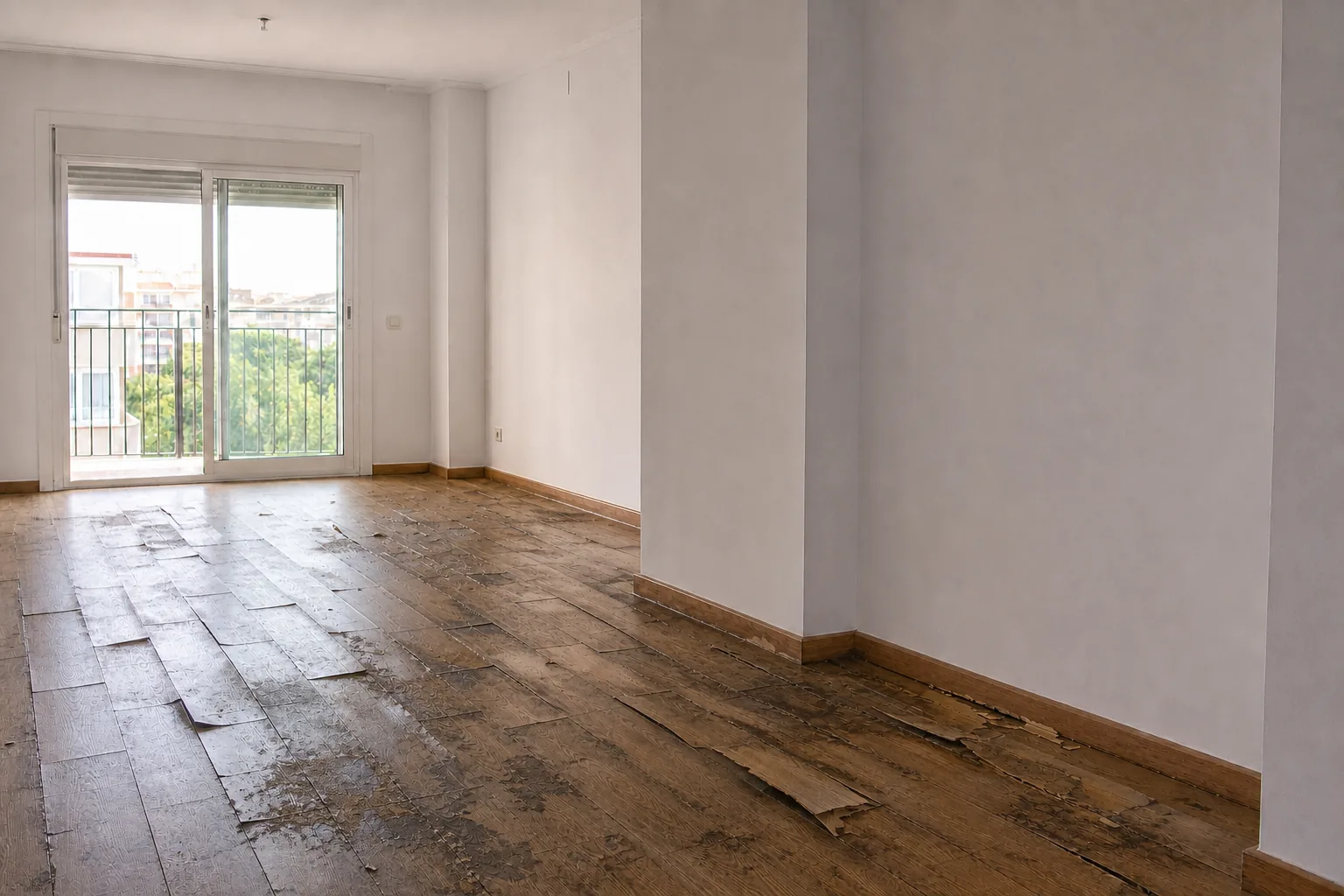
Live synthetic example
One photo, one high-severity finding, one linked repair estimate and ten inventoried bundle artifacts.
Finding · 1 of 1
The living room’s entire 25 m² floating laminate floor is broken and affected by moisture.
The EB1 v2 bundle covers the incident and its photographic evidence at closure. The €3,500 repair estimate is a later document linked to the record; it is not presented as content signed inside this bundle.
Built for the AI operating layer
Give a company agent a governed reading surface—not database credentials. SuperProperty returns scoped facts, explicit criteria and exact source references through a boundary with no write operation and no free SQL.
The dedicated query service cannot create, edit or delete operational records. Company, manager and property scopes are applied before results are returned.
Every response carries stable references back to the records used. No hidden ranking and no autonomous visual interpretation are presented as facts.
Stable identifiers, canonical JSON and JSONL, declared fields and a data dictionary make the same operational record usable beyond the interface.
A constrained MCP endpoint serves compatible agent clients through the same read-only boundary. A customer deployment would add tenant identity, authorisation and customer-specific scopes.
Use the same governed data three ways
Spreadsheets, downstream systems and AI agents receive different interfaces, while the operational source remains protected.
UTF-8 exports for portfolio summaries, operational history and evidence. They can feed the Excel workbooks, macros and management reports a team already relies on.
A portable exchange package with canonical JSON and JSONL, a data dictionary, documents, evidence references, SHA-256 checksums and a public verification key.
A constrained MCP and OpenAPI reading surface returns governed facts and source references without database credentials, free SQL or write operations.
One operational system
Managers and administrators work with the same buildings, units and records, with explicit access scopes and a reviewable history.
Buildings, units, occupancy and manager scopes in one operational view.
Entry, exit, inspection and incident records connected to the relevant property and unit.
Photos, findings, documents, facility reports and repair estimates remain linked to their source record.
Ordered events and verification records make later review possible without rewriting the underlying facts.
Product boundary. Repair estimates can be linked to their source record. Formal approval, execution, accounting treatment and tenant attribution are not part of the current version.
Built on HREVN EB1 Core
SuperProperty is the vertical application. HREVN EB1 Core is the independent engine that defines deterministic archives, strict profiles and multi-axis verification. Keeping them separate lets the evidence rules evolve without turning property-specific workflow into the trust root.
Review the live evidence
Inspect the operational example, its evidence bundle and the separate verification axes without relying on an external conversational interface.